

The companies raising the biggest rounds in August aren't necessarily the ones a small team can start.
Chips, compute, energy, and defense attracted large bets. But raising money for infrastructure and finding a business you can test with a small team are different problems.
A few huge rounds can distort the picture
Three rounds accounted for roughly 80% of the funding in my August sample. Meanwhile, the typical round got smaller.
Investors can commit enormous sums to a few companies without becoming more willing to fund yours. A bigger headline total is not a reason to assume fundraising has become easier.
This is a curated sample of announcements, not the whole venture market. I am looking for business ideas worth examining, not proof that they work.
Start with work people already pay for
The companies that interest me here take on work that customers already need done: checking invoices, buying software, keeping books.
You can test some of these ideas with a paying customer before building much software. Doing the work exposes what a demo can hide. Missing records and slow approvals become your problem. So do the exceptions that still need a person.
That is a different starting point from building an AI feature and then trying to find a reason for someone to buy it.
Four companies worth studying
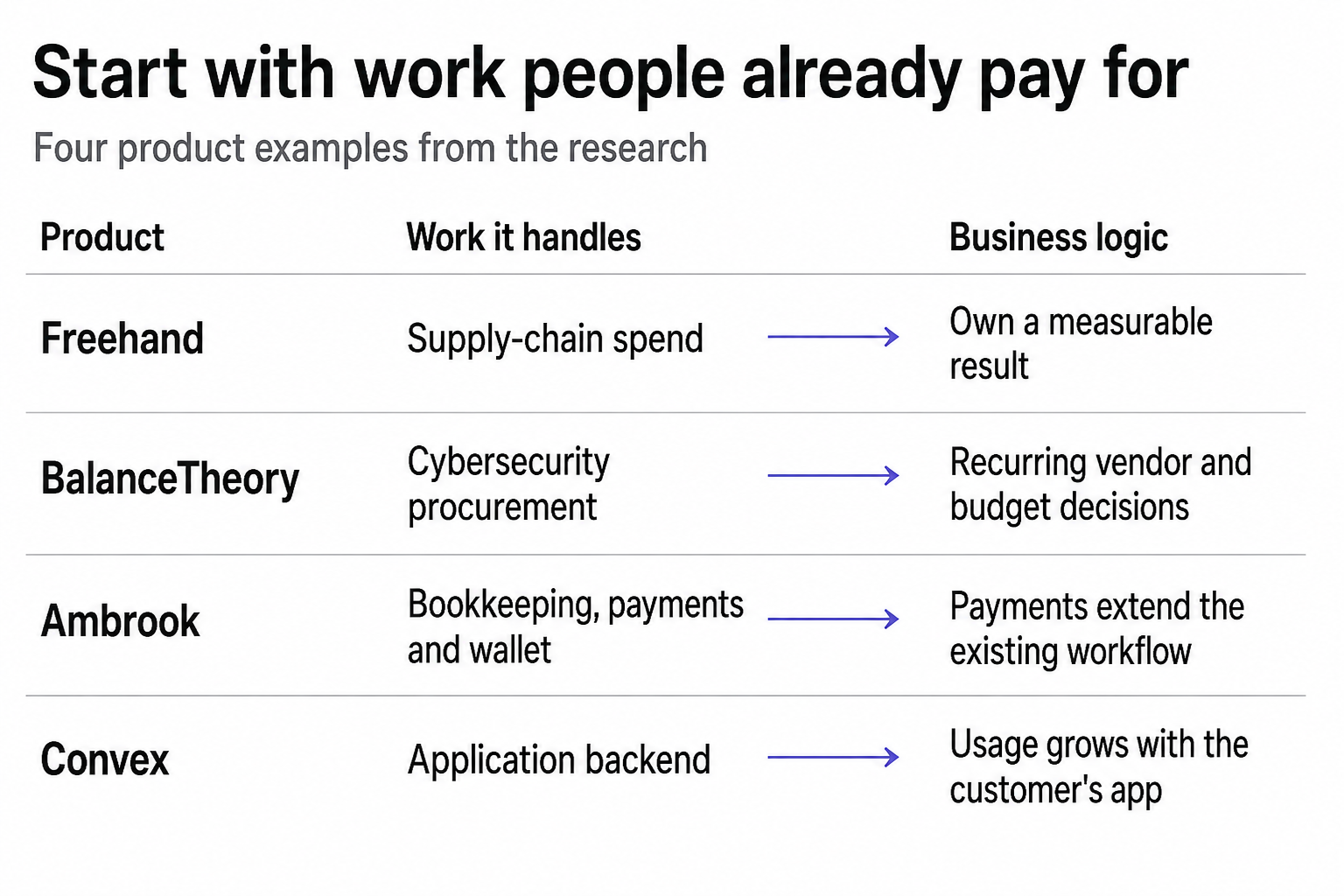
Four current companies show different versions of workflow ownership. I am not claiming they followed the exact sequence below.
Freehand: own the result
Freehand builds AI teams for supply-chain spend. It audits invoices, enforces logistics contracts, validates global trade, and posts data into ERP systems. The work sits close to money companies already lose. It has a budget owner and a measurable outcome.
BalanceTheory: enter through procurement
BalanceTheory applies AI to cybersecurity procurement. It helps customers select vendors and control security spend. Procurement gives it access to recurring vendor and budget decisions.
Ambrook: earn the right to add finance
Ambrook starts with bookkeeping for industries such as farming, construction, and trucking. It also offers payments and a wallet. Bookkeeping creates recurring use, financial data, and trust. Payments extend work the product already controls.
Convex: make usage expand naturally
Convex provides a backend with a database, functions, workflows, sync, search, storage, and authentication. Usage grows as a customer's application relies on more of the backend.
All four control work that repeats and produces a result someone already values.
A capital-light sequence for testing the idea
The August sample suggests a practical order of operations for a lean founder:
- Find an expensive job that happens often.
- Sell one completed result before building the full product.
- Get access to the real workflow, data, and exceptions.
- Automate the operations that repeat.
- Charge recurring revenue for recurring responsibility.
- Add usage, transaction, or outcome pricing when it maps to additional value.
The first sale answers a simple question: does this result already have a budget? Manual delivery exposes what a product brief hides. You learn which systems must connect, where approvals stop the flow, and which edge cases consume the margin.
The second revenue layer should emerge from the workflow. Start with the job. Let pricing follow the value.
Kill the idea when the workflow is weak
AI has made weak ideas cheaper to build. They are still weak.
I would stop or reshape a workflow business when one of these conditions appears:
- The work happens too rarely to support recurring use.
- The result costs too little for anyone to own a budget.
- Customers will buy an audit but will not grant access to the workflow.
- Every delivery is custom, so automation does not improve the margin.
- The product does not accumulate useful state, history, or trust.
- A customer can remove it without changing an important process.
- The second revenue layer requires a behavior the product has not earned.
These signals tell you whether you are building a business or a temporary feature.
MCP may change the front door
There is one new version of this thesis that I am watching closely.
The next consumer product may begin when a user gives an AI agent an intent. The agent can discover a service, call it through MCP, request confirmation, and return the result.
In that model, chat captures demand. MCP provides the machine interface. The product still owns the state and completes the work.
This can make some businesses resistant to AI because AI becomes part of their foundation and distribution. MCP alone is not a moat. A competitor can expose the same tools.
Protection still comes from the layers behind the tool call: proprietary data, supply, workflow history, transaction execution, fulfillment, permissions, reliability, and trust.
The regular interface remains important for comparison, edits, confirmation, exceptions, and history. The product may be agent-first and interface-complete.
This is a thesis, not a proven acquisition model. I have not found enough public cohort data to claim better retention or lower acquisition cost. Test one complete job with a small review interface. Measure completed actions, repeat agent use, confirmations, failures, and reversals.
If the agent can start the job but the product cannot complete it reliably, the new entry point changes nothing.
What should founders build now?
The biggest funding headlines are not necessarily the best starting point for a founder. An expensive recurring job can be. Sell the result while the product is small. Earn workflow access. Automate what repeats. Add revenue when the product controls more value.
AI can lower the labor cost. MCP may lower the distribution and integration cost. Neither one creates the underlying demand.
The business begins with a job that already matters.
You can explore the current public sample in the Funding Map.
Source notes
- August and July cohort calculations: Two Exits Later Funding Map research, September 6, 2026.
- Freehand funding announcement and product details
- BalanceTheory
- Ambrook Series B and product details
- Convex Series B announcement
- Y Combinator Requests for Startups
- Anthropic: Model Context Protocol