
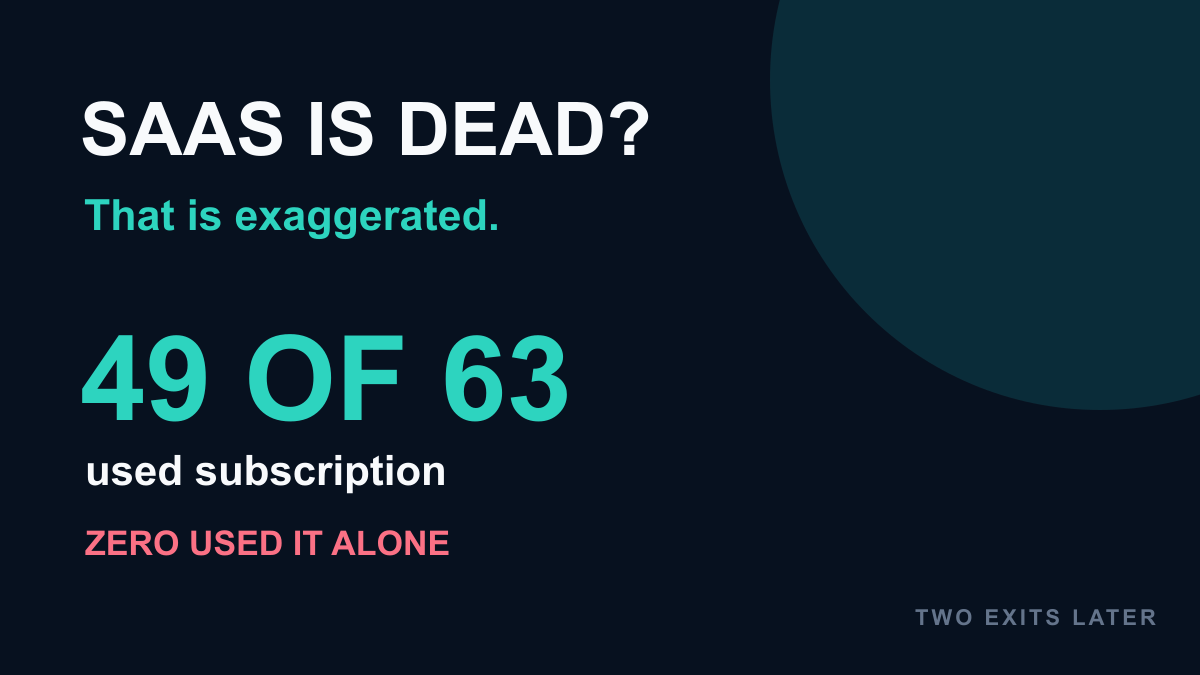
"SaaS is dead" has become an easy claim to make in the AI era.
The data I reviewed does not support it. It shows something more useful: subscription remains common, while subscription-only businesses disappeared from this cohort.
Among 63 non-unicorn companies funded at pre-seed, seed, or Series A in June and July, with low or medium capital intensity, 49 used subscription.
Not one was classified as subscription-only.
That distinction matters if you are choosing what to build next. Recurring revenue is still attractive. Charging every employee for access to another interface is a much weaker default than it used to be.
The cohort
I excluded unicorns and companies with high capital intensity. The remaining 63 companies did not require factories, clinical trials, or heavy physical infrastructure before reaching their first customers.
This is a deliberately narrow cohort. It is useful for founders considering businesses that can begin with relatively little capital. It does not represent every startup funded during the period.
Within this group:
- 49 used subscription, or 77.8%
- 36 used enterprise contracts, or 57.1%
- 19 used usage-based pricing, or 30.2%
- 14 used transaction fees, or 22.2%
- 13 used services, or 20.6%
- 9 used per-seat pricing, or 14.3%
The categories overlap. One company may use subscription, an enterprise contract, and usage-based pricing at the same time.
That overlap is the point.
Subscription no longer describes the whole business
Among the 49 subscription companies:
- 27 also used enterprise contracts
- 16 used usage-based pricing
- 9 used per-seat pricing
- 7 used transaction fees
- 6 used services
- 2 used hardware
- 2 used outcome-based pricing
Subscription in this analysis means recurring payment for access. It does not automatically mean charging a fixed amount for every user.
Only 9 of the 63 companies used per-seat pricing.
The funded companies were often charging for several layers of value: access, implementation, work completed, volume processed, transactions handled, or outcomes delivered.
The recurring payment was the base layer. The rest of the model explained what the customer was repeatedly paying to achieve.
The price of early rounds barely changed
July did not show a dramatic repricing of ordinary early-stage rounds.
Pre-seed median round size moved from $2.5M in June to $2.3M in July. Seed moved from $6.75M to $6.65M. Series A increased from $17.3M to $20M.
The much larger change was the composition of funded companies.
June contained 34 pre-seed, seed, and Series A companies in the dataset, raising $453.9M. July contained 59, raising $1.015B. July also had many more Series A companies, so the totals should not be compared as if the samples were identical.
The useful signal sits inside the models receiving capital.
More capital went to companies that perform the work
Service fees and hardware sales together received 4% of attributed early-stage capital in June and 32% in July.
I calculated this using fractional attribution. If a company had three monetization mechanisms, I assigned one third of its round to each. This avoids counting the same round in full several times.
Service-fee models appeared in 15% of June's early-stage companies and 32% of July's. Hardware appeared in 12% and 20% respectively.
The Agency-to-Software group was particularly interesting. Arrakis, Datapizza, Deutsche Sanierungsberatung, and Dovetail raised a combined $65.3M in July.
They operate in different markets, but share a useful pattern:
- Sell the completed result.
- Enter the customer's workflow.
- Learn which work repeats.
- Automate the repeatable parts.
- Convert the ongoing relationship into recurring revenue.
Service is not automatically a detour from software. It can be the way a company earns access to the work that software should eventually perform.
What the common interpretation misses
AI makes interfaces and software features cheaper to reproduce. It does not make customer workflows simple.
A customer may still need implementation, compliance, data preparation, review, integration, operational responsibility, or a guaranteed result.
That creates room for a broader pricing stack:
- a paid audit or initial project
- a recurring subscription for continued readiness or access
- usage pricing for heavy processing
- a transaction fee when money moves
- outcome-based pricing when results can be measured cleanly
The exact combination depends on the work. Adding every mechanism would make the offer harder to understand. The point is to connect recurring payment to recurring value, then charge separately when another cost or result scales differently.
The boundary of the finding
If I include high-capital early-stage companies, subscription is no longer the most common mechanism. Enterprise contracts narrowly lead, 58 companies to 57.
So the defensible headline is not "subscription wins among all early-stage startups."
It is this:
Subscription was the most common monetization mechanism among capital-light early-stage companies funded in June and July.
Funding also measures investor demand, not customer demand. A funded company can still fail to acquire customers, retain them, or build healthy economics.
This dataset is one signal for choosing an idea. It should sit beside direct customer access, willingness to pay, observed behavior, and your ability to execute in that market.
How I would apply it to a new idea
I would not begin by asking whether an idea can become SaaS.
I would ask which valuable result repeats.
Can I sell that result manually before building the full product? Does delivering it give me access to a real workflow? Which parts repeat often enough to automate? After the first result, what continuing responsibility would justify a monthly payment?
This creates a practical sequence:
Paid audit or first result -> recurring care subscription -> usage or portfolio pricing -> selective outcome-based upside.
Each step must solve a real customer problem. Calling consulting software changes nothing.
Reports of SaaS's death are exaggerated. I would still avoid making "SaaS" the first word of an investor pitch. Dry labels explain less than the customer result and the economics behind it.
Subscription is not disappearing.
It is becoming the base layer of a broader business model.
The practical question is no longer, "Can I charge monthly?"
It is, "What recurring value sits behind that monthly charge?"
Method note: the analysis uses the canonical Two Exits Later June-July 2026 funding dataset. Monetization categories overlap. Capital-share comparisons use fractional attribution across every mechanism assigned to a company. Round totals and medians reflect the observed sample, not the full global funding market.